Saturday, August 1, 2015

Chaper # 6 Consumer Decision Making

How Tesla is changing consumer behavior, the world and the way we buy cars:

Tesla’s story is one that’s difficult to not fall in love with. Its vision of the future is enchanting. Per Elon Musk, Tesla’smission is to accelerate the advent of sustainable transport by bringing compelling mass market electric cars to market as soon as possible. Tesla goals:

  1. Build a (electric) sports car that everyone wants (Roadster)
  2. Use that money to build an affordable car (Model S)
  3. Use that money to build an even more affordable car (Model 3)
  4. While doing the above, also provide (via owned or partnered solutions) zero-emission electric power offerings to build out the infrastructure to support the cars and a new standard of energy (Supercharger network, Powerwall, offering a modestly sized and priced solar panel from SolarCity, etc.)

Why Tesla has the most loyal customers:

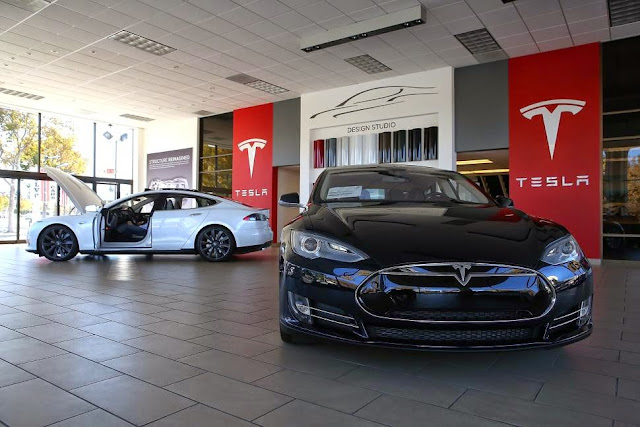
Tesla Motors' (TSLA) cult-like following has catapulted the electric-car upstart into a global market flush with adoring fans. Unlike traditional automakers such as Ford and GM, Tesla doesn't have a massive advertising budget, nor does it conduct multinational marketing campaigns. Instead, Tesla relies on word-of-mouth marketing and mall showrooms for selling its cars. This works because of Tesla's tremendous brand loyalty.
In fact, Tesla Motors received the highest owner satisfaction score in Consumer Reports' annual survey last year. According to the magazine, "Owners of the Tesla Model S gave it the highest owner-satisfaction score Consumer Reports has seen in years: 99 out of 100.
Make an enemy
Tesla's enemies, on the other hand, are vehicles with internal combustion engines and big automakers. Many EV drivers today derive an emotional attachment from driving something that isn't your typical gas-powered car. 
Another advantage for Tesla is the fact that it offers customers something different: new tech from a new company.
Tesla has also created an enemy out of auto dealer associations, which are fighting Tesla's disruptive model of selling its cars directly to consumers through its own company-owned retail stores.
Scores of Tesla drivers have expressed their loyalty to Tesla by showing up in person at state capitols to protest dealer suits against the EV maker in various states such as Texas and Missouri.According to various psychological studies, this outpouring of support and loyalty wouldn't be nearly as strong without an enemy, so perhaps the ongoing dealership battles are a blessing in disguise.
Establishing an emotional connection
Another way that psychologists explain brand loyalty is through emotional connection. All of the most recognizable brands today have one thing in common: They make an emotional connection with consumers. One of the easiest ways for a brand to do this is by standing for something. 
Tesla wins major points in this regard because it is passionately dedicated to promoting mass adoption of electric vehicles in hopes of one day solving our planet's energy problem. People feel good about driving a Tesla because they no longer need to buy gas, and as a bonus, they're helping the planet in the process.
Many Tesla drivers have launched meet-ups or social gatherings for fellow owners and enthusiasts to connect with one another.
Consumer reports
In today's increasingly social world, transparency is key for creating enduring brand loyalty. Companies want to build lasting relationships with their customers, and one way to do so is through open communication. No automaker does this better than Tesla Motors.
Tesla in recent years has built its reputation for quality and customer support by communicating with consumers on social media and its own blog.

Sunday, July 26, 2015

Chapter 5: Developing a Global Vision

                                      Developing a Global Vision

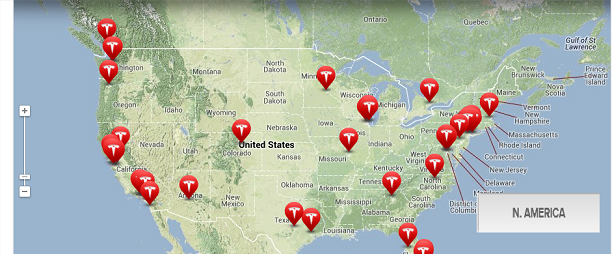
Tesla Motors global headquarters is located in Palo Alto, California. Tesla facilities are worldwide, including: Canada, Europe, Asia & Australia. To attract the global market, Tesla Motors opened there first retail store in Los Angeles, CA in 2008, with other retail stores throughout the United States.


The Model S started in the USA show rooms and now a star overseas.


In Europe, the Model S is Norway's bestselling car.


The Model S ranked as the top selling plug-in electric car in North America during the first quarter of 2013 with 4,900 cars sold, ahead of the Chevrolet Volt (4,421) and the Nissan Leaf (3,695). 


Tesla has its eyes set on China. Air pollution is damaging the health condition of Chinese people and the government being a strong supporter of electric vehicles. With strong sales  in the USA, it has struggled in China, selling just 120 cars last month. Tesla blaming this on production delays and shipping problems.

Chapter 4: The Marketing Environment


 The specific strategy of Tesla's brand positioning:
1. Establishes the shareholder value and marketing partner.
2. Keeps the sustained increasing incomes and profits.
3. Formulates the higher but affordable prices when its market is steady growth.
4. Builds customers fidelity, giving the satisfied services and product.
5. Provides resistance to competitive attack and a source of pride for employees in order to improve the brand effect and business confidence.

Tesla's Research Budget: 

Tesla Motors spent US $81.5 million on research and development in the first quarter, about half again as much as in the same period last year. That expense alone accounted for a little over half the company's $50 million operating loss.
Not that there's anything wrong with that. It costs money to make expensive technology cheap, and that's just what Tesla is laboring to do.
The Model X "will sell for around $30 000," says Bruce M. Belzowski, the director of automotive analysis at the University of Michigan's Transportation Research Institute, in Ann Arbor, Mich. "This is a $40 000 to $50 000 reduction from its Model S, so they are spending R&D dollars to try to find out how to do this."
The Model S is an all-electric sedan with eye-popping performance; the Model X will be built on the same platform but as a full-size SUV, with an extra bank of chairs to carry more people. That'll add 10 percent to the weight, which means that the main tech challenge is to keep the performance eye-popping at a much lower price.
Other tech additions include what the company calls falcon-wing doors; like gull-wing doors, they open upward, but unlike them, they meet in a hinge. Although it says it wants to swap them for cameras and in-dash displays, Tesla will have to include side-view mirrors.
The rule of thumb is that it takes anywhere from $1 billion to $3 billion to develop a major new car model. At Tesla's current R&D burn rate, it should therefore bring out a new car every three to nine years. In fact, it expects to launch the Model X a little more than a year from now—or about three years after the Model S.
"This is a company that is at the cutting edge of pure electric vehicle design," Belzowski says. "If they aren't spending large amounts of R&D money, they aren't doing what we expect them to do."


Monday, July 20, 2015

Tesla SWOT Analysis

                                                                               Tesla SWOT Analysis:

SAWAT - identifying internal strengths (S), and weaknesses (W) and also examining external opportunities
(O) and threats (T)

Strength:
1. They developed 1st fully electric sports car “The Roadster”


2. Also a strong supplier to other manufacturers like Toyota
3. Strong technological expertise in the area of electric transmissions & drive train
4. Ability to  develop vehicles completely in house including the sub-assemblies required
5. Their current platform developed for Model S has the ability to be used for their future crossover model or any other model they envision

Weakness:


1.Since they fully develop the vehicles including their sub-assemblies this leads to higher costs of production as economies of scale are not achieved
2.The prices of their products are higher than their competitors who sell combustion engine powered vehicles


Opportunity:


1. The growing support by governments across the globe for environmentally friendly vehicles in form of exemptions from duties & other support
2.Supports the Mercedes’ Smart car, which can lead to learning which will help them with their passenger cars which they plan to launch in near future
3.Improvements in the quality control processes can reduce these costs drastically


Threats:


1. Tesla wants to be able to produce, distribute & sell its cars to average which seems difficult to achieve due to their current business model
2. Their strategy for pricing (skimming) has not been used so far in the auto industry
3. They are currently competing against a technology which has been in use for over hundred years i.e. the combustion engines& also their technology may take time for being optimal for use of masses


The Mission of Tesla.


''Tesla’s mission is to accelerate the world’s transition to sustainable transport.''
     Our goal when we created Tesla a decade ago was the same as it is today: to accelerate the advent of sustainable transport by bringing compelling mass market electric cars to market as soon as possible. If we could have done that with our first product, we would have, but that was simply impossible to achieve for a startup company that had never built a car and that had one technology iteration and no economies of scale. Our first product was going to be expensive no matter what it looked like, so we decided to build a sports car, as that seemed like it had the best chance of being competitive with its gasoline alternatives.
     Tesla Motors was founded in 2003 by a group of engineers in Silicon Valley who wanted to prove that electric cars could be better than gasoline-powered cars. With instant torque, incredible power, and zero emissions, Tesla’s products would be cars without compromise. Each new generation would be increasingly affordable, helping the company work towards its mission: to accelerate the world’s transition to sustainable transport.
      Tesla’s vehicles are produced at its factory in Fremont, California, previously home to New United Motor Manufacturing Inc., a joint venture between Toyota and General Motors. The Tesla Factory has returned thousands of jobs to the area and is capable of producing 1,000 cars a week.

      Tesla is not just an automaker, but also a technology and design company with a focus on energy 

About Tesla Motors, Inc.


      Tesla Motors, Inc. is an American automotive and energy storage company that designs, manufactures, and sells electric carselectric vehicle powertrain components, and battery products. Tesla Motors is a public company that trades on the NASDAQ stock exchange under the symbol TSLA. In the first quarter of 2013, Tesla posted profits for the first time in its history.

       
Tesla first gained widespread attention following their production of the Tesla Roadster, the first fully electric sports car.  The company's second vehicle is the Model S, a fully electric luxury sedan, and its next two vehicles are the Models X and 3. Global cumulative Model S sales passed the 75,000 unit milestone in June 2015.

       
Tesla also markets electric powertrain components, including lithium-ion battery packs to automakers including Daimler and ToyotaCEO Elon Musk has said that he envisions Tesla Motors as an independent automaker, aimed at eventually offering electric cars at prices affordable to the average consumer. Pricing for the Tesla Model 3 is expected to start at $35,000 before any government incentives and deliveries are expected to begin by 2017. In 2015, Tesla announced the Powerwall, a battery product for home use.